
On 1-2 July 2026, the EVERPV project held its Scientific Workshop, “PV Module Recycling: Technologies, Materials and Circularity Challenges,” at CSEM in Neuchâtel, Switzerland.
The two-day workshop brought together researchers, recycling technology developers, industrial stakeholders and circular economy experts. Together, they discussed the latest progress in photovoltaic (PV) module recycling, material recovery and circular value chains.
Solar PV deployment is increasing in Europe, with larger volumes of end-of-life modules expected in the coming years. This presents a challenge, but also an opportunity for the recovery of valuable materials, waste reduction, and the strengthening of the European solar industry.
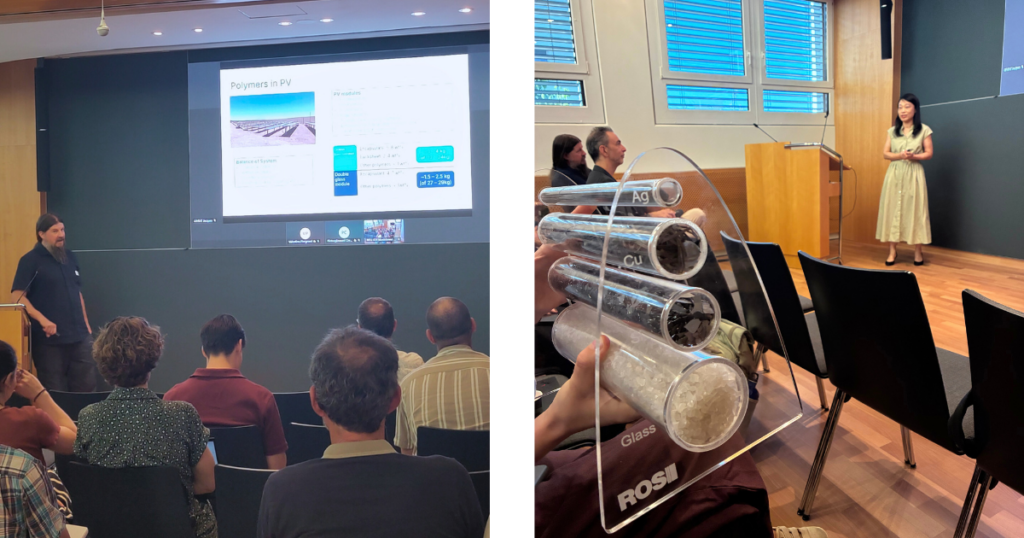
Advancing high-value PV module recycling
During the workshop, speakers discussed recycling technologies that go beyond conventional shredding. A key focus was on selective separation techniques, including mechanical and infrared-assisted delamination methods. These approaches aim to recover cleaner material fractions and preserve the quality of glass, silicon, silver, copper and polymers.
Presentations from EVERPV partners and external experts also showed that recycling performance should not be measured by volume alone. Glass makes up the largest part of a PV module by weight, but materials such as silver and silicon are important for the economic value of recycling. High-value material recovery is therefore essential for effective recycling models.
Another important theme was polymer recycling. It remains one of the most complex areas of PV circularity. Encapsulants, backsheets, and additives can be difficult to separate and process. Successful recycling depends on technical feasibility, collection systems, material quality, processing costs, and market demand.
The workshop also addressed life-cycle assessment, industrial recycling initiatives, reuse strategies and international research activities. Speakers highlighted the need to assess recycling routes from a broader perspective. Key factors include carbon footprint, resource efficiency, environmental impacts, and material value retention.
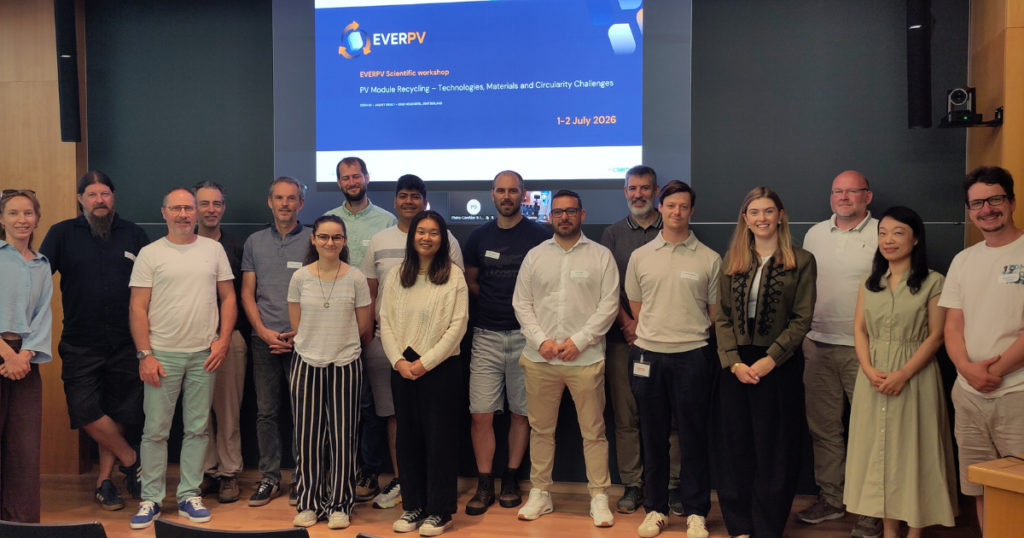
Next steps for circular PV value chains
The event concluded with a roundtable discussion on “The Future of PV Circularity: Opportunities, Challenges and Market Pathways“. SolarPower Europe moderated the discussion with representatives from ROSI Solar, EPRI and CEA.
Participants agreed that technology alone cannot establish a circular PV industry. Scaling recycling solutions will also require supportive policies, collection systems, investment certainty, industrial collaboration, and stronger market demand for recovered materials.
The discussion also emphasised the need for research and innovation activities that address real industry needs. Circularity projects can support more practical solutions with stronger market potential by focusing on the needs of manufacturers, recyclers, and other stakeholders.
Our latest EVERPV Scientific Workshop showed strong progress in PV recycling technologies. It also highlighted the work still needed to scale circular solutions. As Europe prepares for increasing volumes of end-of-life PV modules, projects like EVERPV are helping to build the technical and industrial foundations for a more circular solar sector.
Read the full report here.
